
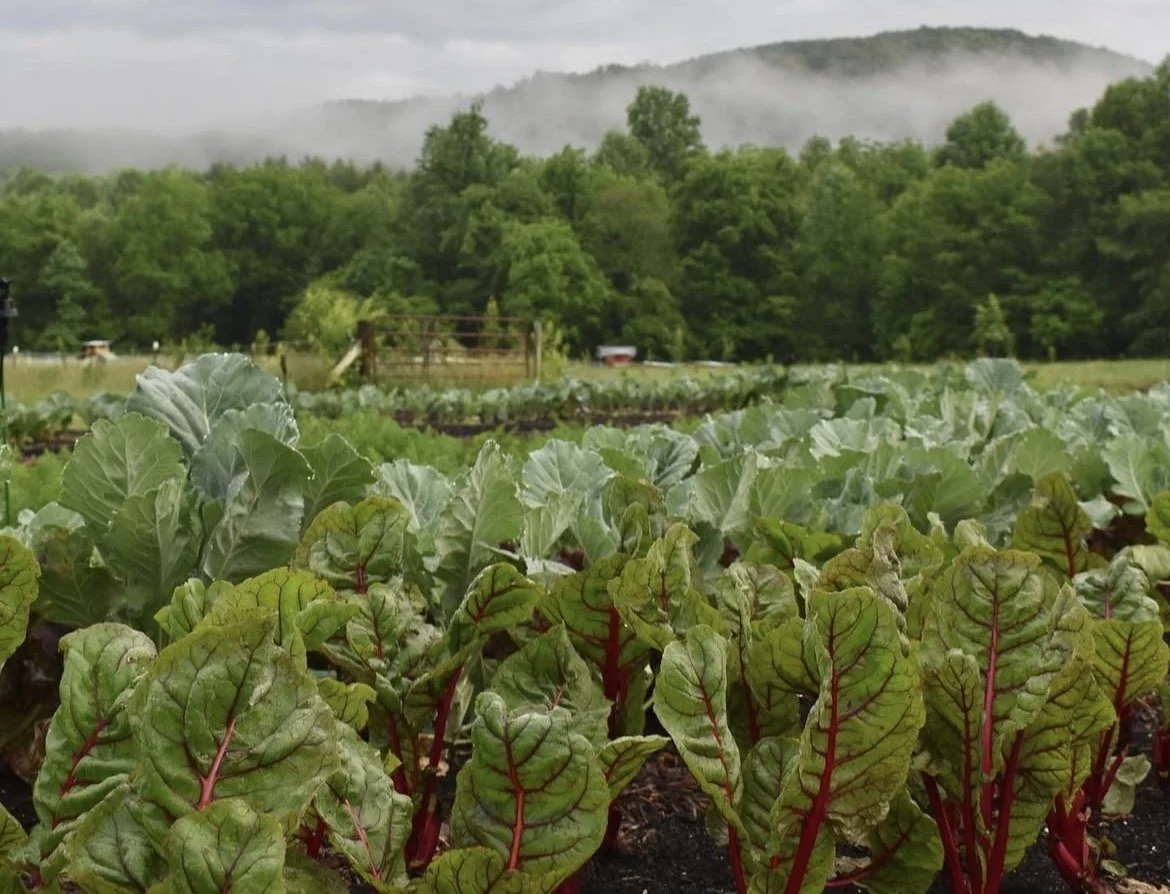
Image credit: Wild East Farm in Marion, NC
Since officially organizing in June 2025, we have been very heads-down ~ and have accomplished quite a bit! This is our first update to share what we’ve been up to, where we are, and where we’re heading next.
Our Role as Catalyst
Since April 2025 when Andrea & Holly first came together, we have been observing, listening, and whiteboarding (many, many conversations and whiteboard sessions!) while holding one central question:
How do we bring our passion, experience and unique gifts to serve our shared vision of a healthy regional food economy in WNC ~ one that sustains itself beyond the need for charitable and government subsidies?
From the beginning, we have been clear that anything we do must be centered around smaller-scale family farms ~ the foundation of any regional food system. Without healthy, happy local farmers, there is no (real) food ~ just a bleak future filled with chemicals, factories and control.
Western North Carolina is home to more than 5,000 small family farms, ten food hubs, forty farmers markets, and a nationally recognized farm-to-table culture. And yet only 4% of the food purchased in this region is grown here. Our 10-year target is to have 25% of the food eaten in WNC grown and raised by local family farms.
This will require different infrastructure and economic incentives than currently exist ~ providing the connective tissue for a food ecosystem that will allow far more of the food, financial capital and other resources to circulate within our regional foodshed.
Blue Ridge Foodshed Commons was founded to bring that into form. Our role is to serve as a catalyst ~ integrating and strengthening what already exists, innovating where gaps remain, and channeling regenerative capital into the initiatives that can shift the system for the long term.
Establishing a Framework for Long Term, Systemic Change
Over the past year, we've moved from vision to foundational infrastructure ~ thoughtfully and with devotion to our mission at every step.
Legal & Governance
Established as a Delaware Public Benefit LLC, with a Certificate of Authority in North Carolina ~ a legal structure that puts mission above profit from the start; Operating Agreement in place
Strengthened the organization’s finance capacity by welcoming Jean-Paul Lausell to our team of Core Stewards
Established weekly team meeting rhythm and structure with agenda, tracking of short- and long-term deliverables, and coherence building
Developing a Perpetual Purpose Trust (inspired by Patagonia's model) ~ ensuring BRFC can never be sold, acquired, or mission-compromised
Financial
Fiscal sponsorship with Abundance Capital, enabling us to receive philanthropic contributions for operations
New fiscal sponsorship with Realize Impact
Multi-donor Donor Advised Fund in development with Abundance Capital ~ a pool of capital to provide grants and zero/low-interest loans to our portfolio of initiatives
Facilitated a $250,000 grant from the Hearst Foundation to the WNC Food Coalition
Over $460,000 in grants received or committed to date (more on this below)
Relationships & Presence
Cultivating deep, active relationships with food hubs across the region, the WNC Food Coalition and their WNC Food Hub Collaborative ~ supporting the middle layer that is key to bringing consistent sales outlets and efficient aggregation & distribution for our farms
Developing relationships with Carolina Farms Fund (part of the Conservation Fund) and Foothills Conservancy around land preservation and access for farmers, especially livestock
In conversations with dairy farmers and large purchasers to create pathways for the revival of local dairy farming and creameries in WNC
Supporting the development of a mobile abattoir and butchery business to expand custom-exempt meat processing in the region
Nurturing relationships of trust with organizations in the global regenerative movement: the BioFi Project (bioregional finance), Ma Earth (regenerative funding), the Rooted Fund, Earth Regeneration Alliance, Metabolic, and others
Participated in the first-ever BioFi Cultivator, with 22 bioregional organizing teams from across North, Central & South American and Hawai’i
Invited to attend the Climate Underground conference (on Al Gore’s farm in Tennessee); facilitated a roundtable at the Purpose Trust Ownership conference in Austin; Holly presented about BRFC at the WithLife Retreat in Asheville and the Pratt Institute in New York
Launching Now: The Foodshed Cultivator
On June 17th, we will launch our first major initiative: the Foodshed Cultivator ~ a six-month venture studio and ecosystem incubator for key food-system stakeholders to advance multi-stakeholder initiatives in our region.
Our first cohort brings together four food hubs spanning the central WNC region ~ TRACTOR (Mitchell County), Foothills Food Hub (McDowell County), Terramonga Food Hub (Buncombe County), Smoky Mountain Harvest Hub (Haywood County), as well as the WNC Food Systems Coalition. For six months, we will work together to deepen relationships of trust essential for interoperating and to expand our regional capacity for institutional purchasing.
Two things about this initiative are worth highlighting. First: unlike typical venture studios that charge fees or take equity stakes, we are paying each participating organization $5,000 ~ honoring their time, wisdom, and expertise. Second: more than just a program, the Cultivator is a living prototype for the participatory governance and collaboration models we are developing for the broader food ecosystem. The relationships built here will seed the collective action needed for regional food sovereignty.
Where We're Headed
We have identified four strategic priorities ~ interrelated leverage points that are critical to the thriving of small family farms and a resilient local food economy:
Strengthen and integrate the local food supply chain
Increase institutional & commercial purchasing of local farm food
Ensure land access for farmers in our region
Increase awareness of the true value of local food
In service of these priorities, we’re actively working on a synergistic portfolio of multi-stakeholder initiatives to address the highest-priority, highest-impact interventions in our food system:
Institutional purchasing
Regional meat processing
Revival of family dairy farms in WNC
Ensuring land access for farmers
These initiatives will continue to evolve as we learn and co-create with those who are at the heart of our regional food ecosystem.
How We've Been Funded
We want to share something about the funding we've received, because the how of it matters as much as the numbers.
In December 2025, we received our first grant ~ $100,000 for operating expenses from an individual philanthropist who believed in what we were building. In April, a $5,000 microgrant from the Resilient Futures Co-Lab (facilitated through our relationship with Metabolic) helped fund food hub participation in the Foodshed Cultivator. Also in April, another philanthropist contributed $25,000 unrestricted, while our first donor provided a $30k grant and committed to an additional $100,000 to arrive in October.
In May, Holly presented an overview of the BRFC model at the WithLife Community retreat in Asheville ~ a gathering convened by John Fullerton's Capital Institute and nRhythm for leaders engaged in regenerative economics and systems change. The response was extraordinary. A philanthropist in attendance was so deeply moved that they made a $200,000 unrestricted grant the following week.
In total, we have received or have firm commitments for over $460,000.
We have been so thankful to witness how this has come about. With the sole exception of a single microgrant application, we have not pitched for any of it. Every grant has arrived through relationship, through presence, through the quality of what we are building and the way we are building it. Resources have flowed toward coherence and foundation-laying, rather than performance and short-term results. This is truly the regenerative model doing its work!
An Invitation
This is a collective effort in the truest sense, and that means we would be honored to have you in the conversation. We would love to hear from you. Ideas, questions, connections, please bring them our way. Thank you for your support in co-creating a thriving local food ecosystem in Western North Carolina!
With deep gratitude and genuine excitement for what's unfolding,
Holly McCann
Andrea DuVall
Jean-Paul Lausell
Core Stewards, Blue Ridge Foodshed Commons
